
Iceland: SmartSolo Nodes Help Image the Shallow Structure beneath Askja
Iceland · Volcano research and ambient-noise tomography
Cambridge and Icelandic researchers combined a temporary nodal array with broadband observations to investigate Askja’s shallow volcanic structure.
A focused array inside the caldera
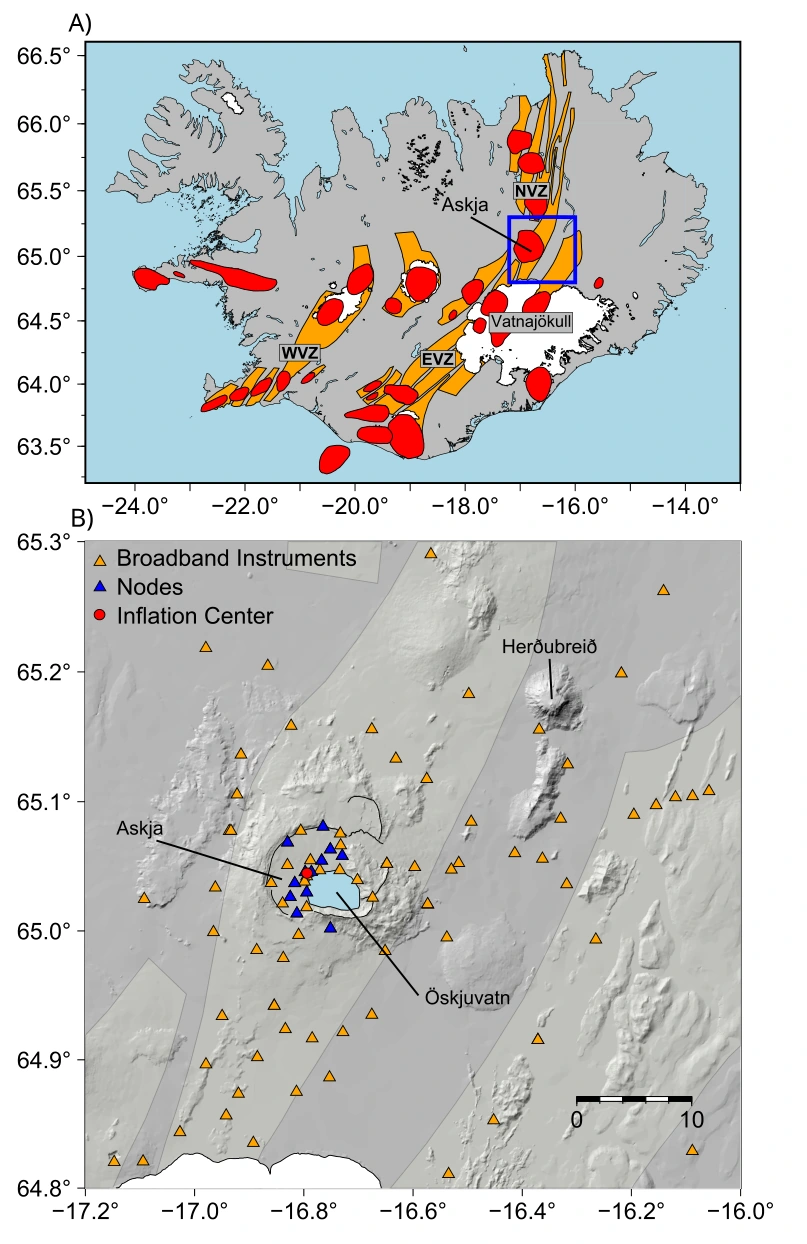
In response to renewed inflation at Askja, researchers installed a dense seismic network in the caldera. Fone and colleagues’ 2025 JGR: Solid Earth paper describes the 2023 deployment and its contribution to ambient-noise tomography. Source
The instruments used in the study
The paper specifies 12 three-component 5 Hz SmartSolo geophones alongside 10 broadband instruments in the temporary network. It identifies the SmartSolo units as coming from Iceland’s jointly owned LOKI instrument pool. The study also used longer-term regional seismic observations. Source
Research findings and their scope
The authors imaged a shallow low-velocity zone approximately two kilometres beneath the surface and interpreted it as a magma-storage region. The interpretation combines seismic imaging with other observations; it is not a direct measurement of magma volume or a prediction of eruption timing. Source
A documented acquisition and data archive
The BGS dataset catalogue attributes the node recordings to the Universities of Cambridge and Iceland. Its description records 250-sample-per-second acquisition, shallow burial and an irregular layout constrained by walkable terrain. The archive covers summer observations in 2023 and 2024; the instrument count above refers specifically to the published 2023 study. Source
Discuss your volcano-imaging project
Send us the target area, planned station spacing, access conditions and observation period. We can review suitable node configurations and provide a project quotation. For archived research data, use the original repository and its access conditions.
Fone et al. (2025), JGR: Solid Earth, DOI 10.1029/2025JB031905, Figure 1, CC BY 4.0. Original figure extracted from the Cambridge repository copy and converted to WebP; scientific labels retained. View original post
Project and event sources
Explore related instruments and applications
IGU-16HR-3C 5Hz High-Resolution 3-Component Seismic Node · Large-N Passive Seismic Arrays · University Research & Teaching · Earthquake & Long-term Monitoring
Related links support instrument selection; the project description identifies the equipment reported in the source.
Planning a seismic project?
Tell our team about your application, field conditions and acquisition requirements.
Discuss Your Project